Have you ever wondered if the perfect slice of toast is truly attainable? In an age dominated by smart appliances and disposable electronics, one vintage kitchen staple stands as a testament to enduring quality and unparalleled performance: the Sunbeam Radiant Control Toaster. Hailed by enthusiasts and experts alike as a “cult classic,” this isn’t just a toaster; it’s an engineering marvel that consistently delivers golden, crispy perfection, slice after delicious slice. For decades, it has outshone its modern counterparts, proving that sometimes, the old ways are undeniably the best.
The Unrivaled Legacy of Radiant Control Toasting
The Sunbeam Radiant Control Toaster, first patented in 1949, represents a golden era of American appliance manufacturing. Sold for nearly five decades, from its inception until 1995, these meticulously crafted machines were built to last, largely in the United States, with some models even produced in Canada and Australia. Its “cult classic” status is well-earned, drawing comparisons to revered mechanical masterpieces like the Leica M2 camera or the BMW Airhead motorcycle, precisely because no contemporary toaster has truly matched its performance or mechanical elegance. This isn’t just about nostalgia; it’s about a functional piece of art that simply works better than almost anything on the market today.
The Ingenious Radiant Control Mechanism
At the heart of the Sunbeam’s legendary performance is its patented “Radiant Control” mechanism—a marvel of purely mechanical engineering with not a single computer chip or electromagnet in sight. Unlike modern toasters that rely on arbitrary timers, the Sunbeam employs a bimetallic strip, strategically shielded from direct coil heat, which senses the radiant heat emanating from the surface of the bread. This means it measures the actual doneness of your toast, not just how long it’s been exposed to heat.
This ingenious system ensures unparalleled consistency. Whether your bread is fresh or frozen, moist or dry, thick or thin, the Sunbeam adjusts the toasting time automatically to achieve your desired level of golden perfection every time. There’s no lever to push; simply drop your bread into the slots, and a system of cantilevers, actuated by the thermal expansion of internal coils, gently lowers it. Once the bimetallic strip detects the optimal surface temperature, power is disconnected, and the toast gracefully rises. With powerful heating elements, typically ranging from 1275 to 1375 watts, the Sunbeam quickly sears the bread’s surface to a satisfying crispness while leaving the interior delightfully soft and fluffy—a hallmark of truly exceptional toast.
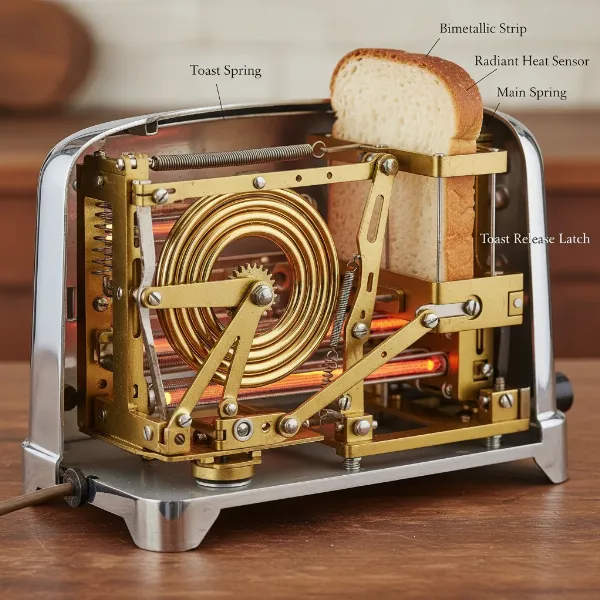 Close-up view of Sunbeam Radiant Control Toaster mechanism, showing bread lowering automatically for perfect toast.
Design and Aesthetics: A Mid-Century Masterpiece
Beyond its internal wizardry, the Sunbeam Radiant Control Toaster is a visual icon, embodying the sleek, functional elegance of mid-century modern design. Its polished chrome exterior, often adorned with Art Deco-inspired scribed lines on earlier T-20 series models, adds a touch of timeless sophistication to any kitchen countertop. The original designs featured elegant Bakelite handles that allowed for safe movement even when hot, with the darkness control knob discreetly tucked underneath—a testament to its thoughtful engineering.
Over its production run, while the core Radiant Control mechanism remained unchanged, minor cosmetic and functional updates were introduced across various models. Later iterations, such as the T-40, sometimes featured a more accessible slider control on the front panel, replacing the hidden knob. Regardless of the specific model, the Sunbeam’s robust construction and refined aesthetics made it a cherished wedding gift and a proud display piece in countless homes.
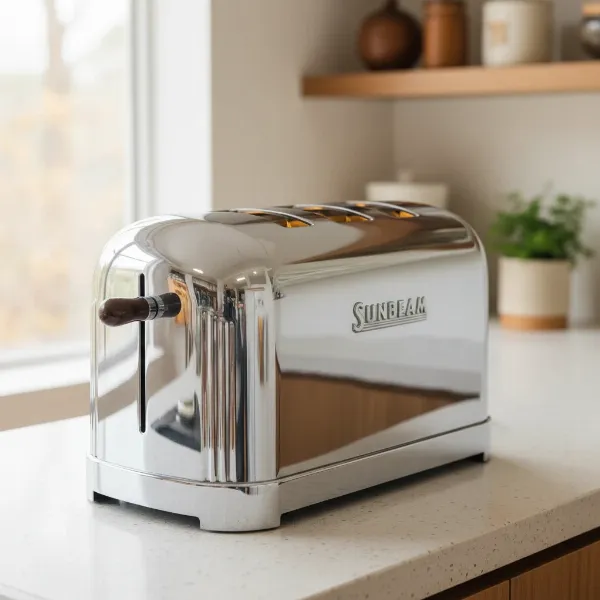 A classic polished chrome Sunbeam Radiant Control Toaster on a kitchen counter, showcasing its mid-century modern design.
A Detailed Look at Key Models (T-20 to AT-W)
The Sunbeam Radiant Control Toaster evolved through several key models, each building upon the foundational design while introducing minor refinements.
- T-20 Series (1949-1958): These early models, including the T-20, T-20A, T-20B, and T-20C, are known for their distinctive Art Deco scribed lines and often featured cloth-covered asbestos power cords. The T-20B notably introduced a more robust return mechanism. Power was typically 1275 watts.
- T-35 (1958-1967+): This popular model largely mirrored the T-20C internally but introduced a gold medallion with “Radiant Control” scripting on the front. It featured a more utilitarian rubber power cord.
- T-40 (1962): The T-40 shifted the darkness control from a hidden knob to a front-facing slide, a change some found less elegant but more convenient.
- T-35-1 and VT-40-1 (1966+): These marked significant safety improvements, being the first to incorporate a double-pole thermostat. This critical feature ensured both the “hot” and “neutral” wires were switched, providing enhanced protection, especially with non-polarized plugs. These models also saw an increase in power to 1375 watts for faster toasting cycles.
- Later Models (AT-W, AT-35-A, etc., 1976-1997): While external appearances could vary, the internal mechanics remained consistent, often including government-mandated insulation covers over wiring, maintaining the 1375-watt power.
Each model, regardless of its specific designation, upheld the core principles of the Radiant Control design: automatic, precise, and durable toast production.
Living with a Vintage Icon: Pros and Cons
Owning a Sunbeam Radiant Control Toaster is a unique experience, offering distinct advantages and some considerations.
Pros:
- Unmatched Toast Quality: The Radiant Control system consistently delivers perfectly browned, crisp toast with a soft interior, superior to most modern, timer-based units.
- Exceptional Durability and Reliability: Built with robust mechanical components, many Sunbeam toasters are still fully functional after 50 or more years, a testament to their engineering and material quality.
- Automatic Operation: The hands-free experience of simply dropping bread into the slots and having it lower, toast, and rise on its own is a touch of pure luxury.
- Timeless Aesthetic: Its polished chrome finish and classic design make it a beautiful addition to any kitchen, especially those with a mid-century modern sensibility.
- Repairability: Unlike many sealed modern appliances, these toasters are often repairable with basic cleaning or minor adjustments to their mechanical components.
|
Our Picks for the Best Toaster in 2026
As an Amazon Associate I earn from qualifying purchases.
|
||
| Num | Product | Action |
|---|---|---|
| 1 | bella 2 Slice Slim Toaster, Fits-anywhere™ Kitchenware, 6 Setting Shade Control with Reheat & Cancel Buttons, Fits Sourdough, 10” Long Slot, Anti Jam & Auto Shutoff, 900 Watt, Surf |

|
| 2 | bella 2 Slice Slim Toaster, Fits-anywhere™ Kitchenware, 6 Setting Shade Control with Reheat & Cancel Buttons, Fits sourdough, 10” Long Slot, Anti Jam & Auto Shutoff, 900 Watt, Blossom |
|
| 3 | STRING SET BASS STD 45w 55w 75w 105w |
|
| 4 | Elite Gourmet ECT1027B Cool Touch Toaster with 6 Temperature Settings & Extra Wide 1.25" Slots for Bagels, Waffles, Specialty Breads, Puff Pastry, Snacks, ETL Certified, 2 Slices, Black |
|
| 5 | bella 2 Slice Slim Toaster, Fits-anywhere™ Kitchenware, 6 Setting Shade Control with Reheat & Cancel Buttons, Fits sourdough, 10” Long Slot, Anti Jam & Auto Shutoff, 900 Watt, Plum |
|
| 6 | Amazon Basics 2 Slice Toaster, With 6 Browning Settings, Extra Wide Slots For Bagels and Special Breads, Removable Easy-to-Clean Crumb Tray, Cancel/Defrost/Bagel Buttons, 900W, Black & Silver |
|
| 7 | KEYWIND VTG RIC DELUXE LONG SE |
|
| 8 | bella 2 Slice Slim Toaster, Fits-anywhere™ Kitchenware, 6 Setting Shade Control with Reheat & Cancel Buttons, Fits Sourdough, 10” Long Slot, Anti Jam & Auto Shutoff, 900 Watt, Seaglass |
|
| 9 | bella 2 Slice Slim Toaster, Fits-anywhere™ Kitchenware, 6 Setting Shade Control with Reheat & Cancel Buttons, Fits sourdough, 10” Long Slot, Anti Jam & Auto Shutoff, 900 Watt, Oatmilk |
|
| 10 | Touch Screen Toaster - 4 Slice, 2 Extra Long Slots - 5 Bread Types and 6 Browning Levels - Defrost, Reheat, Favorite, & Single Slot Modes - For Toast, Bagels, & Waffles – White |
|
Cons:
- Lack of Modern Features: You won’t find specialized bagel settings or defrost modes. While it toasts English muffins perfectly, bagels can be tricky due to their hole interfering with the radiant sensor.
- Safety Considerations for Older Models: Early models (pre-T-35-1) may lack modern safety features like polarized plugs or double-pole switches, which can pose a shock hazard. Using these with a GFCI (Ground Fault Circuit Interrupter) outlet is strongly recommended.
- Bread Size Limitations: American bread slices have grown larger over the decades, meaning some wider modern loaves might require trimming to fit the slots.
- Availability and Cost: As a vintage item, finding a well-maintained Sunbeam Radiant Control Toaster can be a hunt, and prices on secondary markets like eBay can be substantial for units in good working order.
Care and Maintenance for Your Sunbeam Toaster
Maintaining your Sunbeam Radiant Control Toaster is straightforward, ensuring its longevity and continued peak performance.
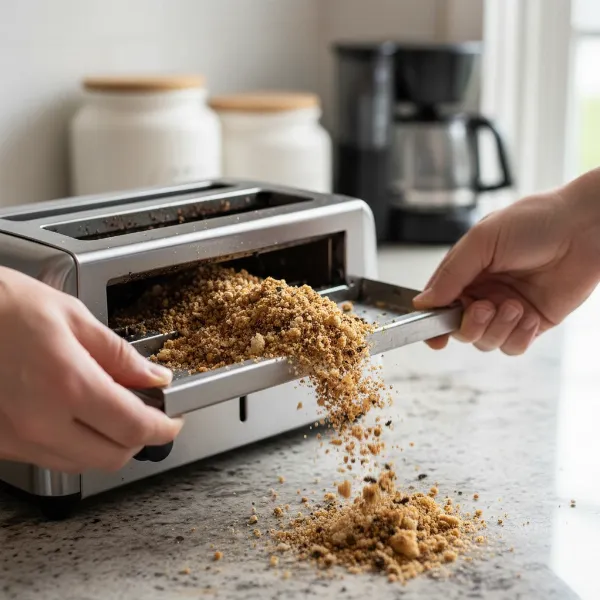
- Regular Cleaning: Like any toaster, it’s crucial to empty the crumb tray frequently to prevent crumb buildup and potential fire hazards. A gentle wipe-down of the chrome exterior will keep it gleaming.
- Addressing Sluggishness: If the automatic drop or raise mechanism becomes sluggish, it often indicates a need for cleaning or a minor adjustment. These toasters have adjustable screws that control the weight sensitivity of the drop mechanism and the darkness setting. Always ensure the toaster is unplugged before attempting any adjustments or internal cleaning.
- Electrical Safety: For models without a double-pole thermostat (generally pre-T-35-1), it is highly advisable to use the toaster only with a GFCI-protected outlet. Regularly inspect the power cord for any signs of fraying or damage and consider professional replacement if needed.
Why Modern Toasters Often Fall Short
In stark contrast to the Sunbeam, many contemporary toasters, particularly those at lower price points, prioritize cost-cutting over quality and performance. They typically rely on simple timers, leading to inconsistent toasting results where bread is often either underdone or burnt, regardless of its initial state. The prevalence of cheap plastics and failure-prone electronic components means modern toasters often have a significantly shorter lifespan, quickly becoming just another piece of recycled waste. The Sunbeam Radiant Control Toaster stands as a powerful rebuttal to this planned obsolescence, a reminder of a time when appliances were built to last, perform flawlessly, and be cherished for generations.
Conclusion
The Sunbeam Radiant Control Toaster is far more than just an antiquated kitchen gadget; it’s a testament to superior engineering, thoughtful design, and a bygone era of unparalleled craftsmanship. Its revolutionary Radiant Control mechanism delivers consistent, perfect toast with an automatic grace that modern appliances often fail to replicate. For those who appreciate enduring quality, a touch of vintage elegance, and the simple pleasure of flawlessly toasted bread, this “cult classic” remains the gold standard.
Isn’t it time we reconsidered what truly makes a great toaster?