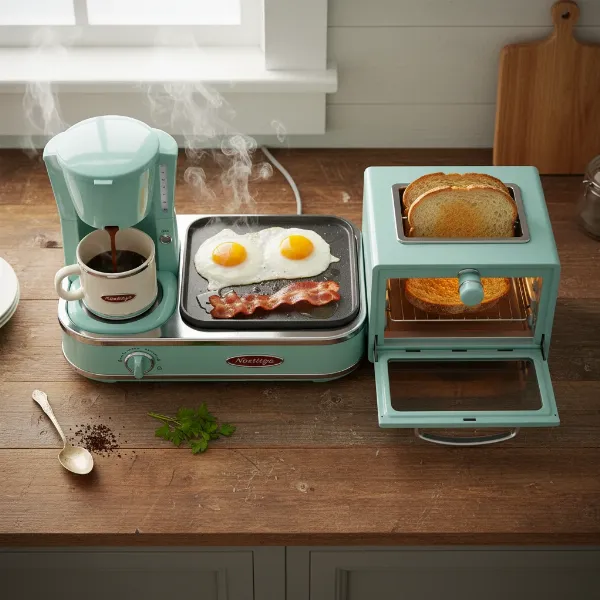
The scent of perfectly golden-brown toast is a simple pleasure, a timeless ritual that begins countless mornings worldwide. Yet, few ponder the remarkable journey of this unassuming kitchen staple. What started as a rudimentary method of preserving bread over open flames has evolved into a sophisticated device, now poised on the brink of intelligent, AI-driven innovation. This is the fascinating story of the toaster, a testament to human ingenuity in pursuit of the perfect slice.
The Dawn of Toasting: Pre-Electric Beginnings
For centuries before the hum of electricity filled our homes, bread was toasted out of necessity and for flavor. Early civilizations discovered that heating bread not only made it crunchier and sweeter but also preserved it longer. From the 16th century onward, people used long-handled metal forks or simple iron frames held over open fires, hearths, or gas stoves to achieve this golden transformation. These early methods required constant vigilance, a skilled hand, and a tolerance for uneven browning, laying the groundwork for the automated convenience we now enjoy.
The Electric Revolution: Early Innovations (Late 19th – Early 20th Century)
The late 19th century ushered in the age of electricity, and inventors soon turned their attention to the art of toasting. The first rudimentary electric toaster emerged in 1893, credited to Alan MacMasters in Scotland, and showcased by Crompton Company at Chicago’s World’s Fair. These pioneering devices used simple iron wires as heating elements. However, they were far from practical; the wires were unreliable, prone to overheating, burning out quickly, and could only toast one side of the bread at a time, demanding manual flipping.
The true breakthrough arrived in 1905 with Albert Marsh, an American engineer. He developed “Nichrome,” an alloy of nickel and chromium, which possessed the remarkable ability to glow red-hot without melting or quickly deteriorating. This durable, heat-resistant wire became the foundation for all subsequent electric heating elements, making reliable electric toasters a tangible reality.
With Nichrome solving the heating element challenge, commercial production began. In 1909, Frank Shailor of General Electric patented the “D-12,” widely regarded as the first commercially successful electric toaster. This cage-like device still required users to manually flip the bread to toast both sides, but it marked a significant step towards modern convenience.
Towards Automation: The Rise of the Pop-Up (1910s – 1920s)
The demand for greater automation quickly spurred further innovation. The Copeman Electric Stove Company introduced a toaster in 1913 that featured an automatic bread turner, eliminating the need for manual flipping. Yet, the ultimate convenience was still elusive: a toaster that would cook to perfection and then automatically signal its completion.
This problem was solved in 1919 by Charles Strite, a Minnesota mechanic. Frustrated by burnt toast in cafeteria settings, Strite invented the timed pop-up toaster. His ingenious design incorporated a timer and a spring mechanism that would automatically cut the power and eject the toast when done. After receiving a patent in 1921, a redesigned version of Strite’s toaster was released for home use in 1926 by Waters-Genter of Minneapolis under the iconic “Toastmaster” brand. This device could brown both sides of the bread simultaneously and pop it up, forever changing breakfast routines.
The burgeoning popularity of the pop-up toaster was further accelerated by another pivotal invention: the bread slicer. In 1928, Otto Frederick Rohwedder created the first machine to slice and wrap bread, and Wonder Bread popularized pre-sliced bread in 1930. The standardization of bread slices perfectly complemented the new automatic toasters, leading to a massive surge in sales and solidifying the toaster’s place in the modern kitchen.
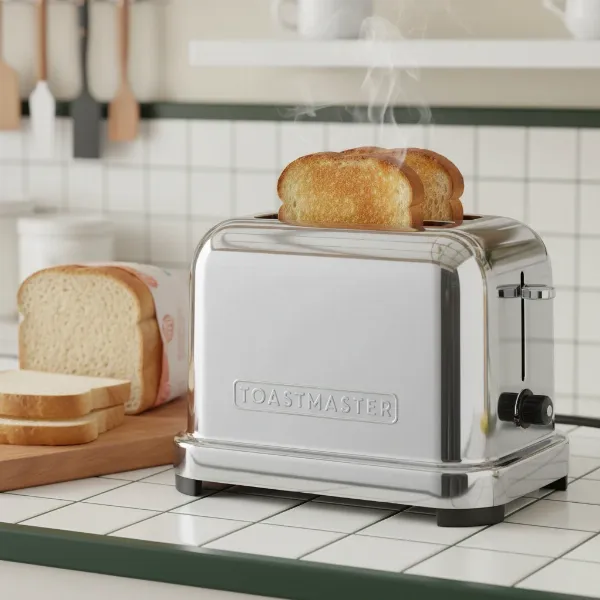 An early model of an automatic pop-up toaster with perfectly sliced white bread next to it.
Mid-Century Modernization: Design and Function (1930s – 1980s)
Throughout the mid-20th century, toasters continued to evolve in both function and form. The 1930s saw sales skyrocket, making toasters more commonplace and affordable. Engineers focused on refining performance, with companies like Proctor Electric and Sunbeam introducing improved bimetal sensor controls in the 1940s, which detected the toast’s actual heat rather than just the heating element, leading to more consistent browning.
The 1950s and 60s brought a wave of design whimsy. Toasters became smaller, sleeker, and more colorful, reflecting post-war optimism and changing aesthetics. Innovations like four-slice toasters appeared in 1958, addressing the needs of larger families. By the 1970s and 80s, the development of heat-resistant plastics offered greater design flexibility, leading to rounded shapes and a wider variety of colors. Manufacturers also introduced wider slots to accommodate bagels and thicker artisanal breads, recognizing diverse consumer needs.
The Smart Toaster Era: Connectivity and Intelligence (1990s – Present)
The turn of the 21st century marked a new frontier for the toaster: the integration of advanced technology and, ultimately, artificial intelligence. The idea of a “smart toaster” began as experimental projects in the 1990s, such as “The Internet Toaster” in 1990, which could be controlled remotely. Early 2000s saw whimsical concepts like a toaster that could burn weather forecasts onto bread using a pre-coded phone number.
However, these experiments paved the way for more practical applications. In 2012, a student at Georgia Tech designed a toaster using color sensors to achieve a user-specified shade of brown, highlighting a shift towards greater precision. Today’s smart toasters leverage Wi-Fi and Bluetooth connectivity, allowing users to control them remotely via smartphone apps. You can adjust settings, monitor progress, and receive notifications when your toast is ready, all from the palm of your hand.
The true intelligence, however, lies in AI optimization. Modern smart toasters use machine learning algorithms and advanced sensor arrays to learn user habits and adapt toasting cycles. They can analyze factors like bread thickness, moisture content, and even ambient humidity to ensure a perfect result every time. Many integrate with virtual assistants like Alexa or Google Assistant, enabling hands-free operation and seamless coordination with other smart home devices. Imagine your coffee brewing precisely as your toast pops up, a perfectly choreographed morning ballet. This level of personalization and convenience elevates the breakfast experience, transforming the toaster from a simple appliance into an intuitive, intelligent kitchen companion.
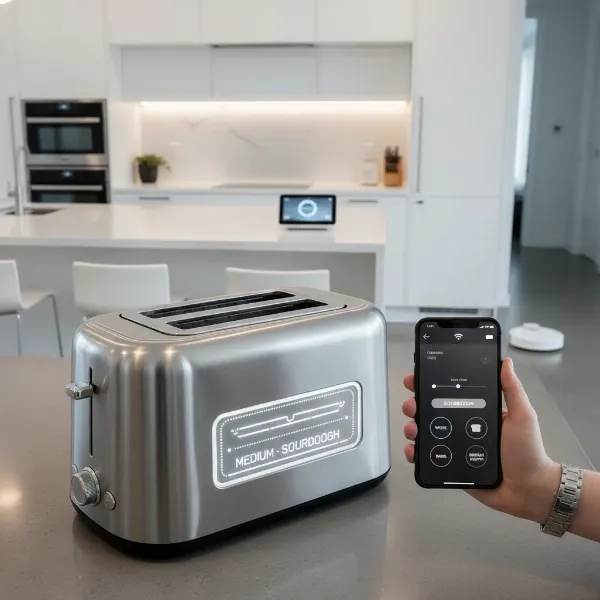 A modern smart toaster connected to a smartphone app, illustrating AI-driven customization.
The Future of Toasting: What’s Next?
As AI and IoT technologies continue to advance, the future of the toaster promises even greater sophistication. We might see toasters with even more refined sensor technology, capable of identifying specific bread types and suggesting optimal toasting settings. Personalization will deepen, with devices learning individual preferences over time to deliver consistent perfection. Integration into holistic smart kitchen ecosystems will become standard, synchronizing breakfast preparation from start to finish. Furthermore, advancements in materials and energy efficiency will likely lead to more sustainable and aesthetically pleasing designs. The humble toaster, a seemingly simple device, continues to be a canvas for innovation.
Conclusion
From its ancient origins over open fires to the iron-wired contraptions of the late 19th century, the toaster has undergone an astonishing evolution. The invention of Nichrome wire, the genius of the pop-up mechanism, and the seamless integration of smart features and AI have transformed it from a basic utility into a highly personalized and intelligent appliance. The toaster’s journey is a microcosm of technological progress, constantly adapting to make our daily lives a little more convenient and our breakfast a little more perfect. So, the next time your toast pops up, take a moment to appreciate the century of innovation packed into that everyday device, and ponder what intelligent marvels await its future.
Frequently Asked Questions
When was the first electric toaster invented?
|
Our Picks for the Best Toaster in 2026
As an Amazon Associate I earn from qualifying purchases.
|
||
| Num | Product | Action |
|---|---|---|
| 1 | STRING SET BASS STD 45w 55w 75w 105w |

|
| 2 | bella 2 Slice Slim Toaster, Fits-anywhere™ Kitchenware, 6 Setting Shade Control with Reheat & Cancel Buttons, Fits sourdough, 10” Long Slot, Anti Jam & Auto Shutoff, 900 Watt, Oatmilk |
|
| 3 | bella 2 Slice Slim Toaster, Fits-anywhere™ Kitchenware, 6 Setting Shade Control with Reheat & Cancel Buttons, Fits Sourdough, 10” Long Slot, Anti Jam & Auto Shutoff, 900 Watt, Seaglass |
|
| 4 | bella 2 Slice Slim Toaster, Fits-anywhere™ Kitchenware, 6 Setting Shade Control with Reheat & Cancel Buttons, Fits sourdough, 10” Long Slot, Anti Jam & Auto Shutoff, 900 Watt, Blossom |
|
| 5 | bella 2 Slice Slim Toaster, Fits-anywhere™ Kitchenware, 6 Setting Shade Control with Reheat & Cancel Buttons, Fits Sourdough, 10” Long Slot, Anti Jam & Auto Shutoff, 900 Watt, Surf |
|
| 6 | bella 2 Slice Slim Toaster, Fits-anywhere™ Kitchenware, 6 Setting Shade Control with Reheat & Cancel Buttons, Fits sourdough, 10” Long Slot, Anti Jam & Auto Shutoff, 900 Watt, Plum |
|
| 7 | KEYWIND VTG RIC DELUXE LONG SE |
|
| 8 | Touch Screen Toaster - 4 Slice, 2 Extra Long Slots - 5 Bread Types and 6 Browning Levels - Defrost, Reheat, Favorite, & Single Slot Modes - For Toast, Bagels, & Waffles – White |
|
| 9 | Amazon Basics 2 Slice Toaster, With 6 Browning Settings, Extra Wide Slots For Bagels and Special Breads, Removable Easy-to-Clean Crumb Tray, Cancel/Defrost/Bagel Buttons, 900W, Black & Silver |
|
| 10 | Elite Gourmet ECT1027B Cool Touch Toaster with 6 Temperature Settings & Extra Wide 1.25" Slots for Bagels, Waffles, Specialty Breads, Puff Pastry, Snacks, ETL Certified, 2 Slices, Black |
|
The first rudimentary electric toaster was invented in 1893 by Alan MacMasters in Scotland, with early models also demonstrated by Crompton Company at the Chicago World’s Fair.
Who invented the automatic pop-up toaster?
Charles Strite invented the timed automatic pop-up toaster in 1919, initially for restaurant use. A version for home use, the Toastmaster, was introduced in 1926 by Waters-Genter.
What is Nichrome wire and why is it important to toaster history?
Nichrome is an alloy of nickel and chromium, invented by Albert Marsh in 1905. It’s crucial because it’s heat-resistant and glows red-hot without melting, making it the ideal durable heating element for electric toasters.
How does an AI toaster work?
An AI toaster uses machine learning algorithms and sensors to analyze factors like bread type, thickness, and moisture. It learns user preferences over time and adjusts toasting time and temperature automatically to achieve personalized browning levels.
What are the benefits of a smart toaster?
Smart toasters offer benefits such as remote control via smartphone apps, customizable settings, real-time notifications, adaptive toasting based on bread characteristics, and integration with other smart home devices and virtual assistants for a seamless, personalized breakfast experience.